


For mobile tire shops, which rely heavily on local marketing, word-of-mouth, and digital outreach, CAC (customer acquisition cost) can be the deciding factor in their long-term success.
High CAC may quickly erode profits, while a well-optimized CAC strategy can fuel growth by maximizing the returns on marketing and sales investments.
This article explores what CAC is, why it’s crucial for your mobile tire shop, and how to manage it effectively to ensure lasting success.
What is CAC (Customer Acquisition Cost):
Definition of CAC:
- The cost of acquiring a new customer
- Calculation:
- Total Marketing Spend (during a given period) / # of New Customers Acquired (during a given period)
- ex. $1500 in marketing spent in last 30 days / 20 new customers = $75 CAC.

Why is CAC Important?:
It affects profitability and growth sustainability.
For mobile tire shops, which operate in a highly competitive space with unique logistical and customer service demands, controlling CAC is pivotal. High CACs can eat into profits, while a well-optimized CAC allows for scalable growth and efficient customer outreach, maximizing each dollar spent on acquisition.
The Components of CAC:
Marketing Costs:
- Digital Marketing
- Google Keyword/Search Term bidding
- Google Shopping/Product listings
- Facebook & Instagram Ads
- Youtube Ads
- TikTok Ads
- Offline Marketing
- Postcard Mailers
- Local event sponsoring (Cars & Coffee)
- Management
- Agency fees to manage ad spend
- Contractor fees (Upwork freelancers, etc)
- Software tools (marketing automations, etc)
- Production
- Ad creative (Video, audio, images, graphic design, etc)

Looking to dig deeper into marketing to grow your mobile tire shop? Check out this article: “5 Strategic Moves To Make in Digital Marketing for Mobile Tire Shops in 2025“
Calculating CAC:
A Step-by-Step Guide
- Determine Total Sales and Marketing Expenses
- Add up all expenses related to acquiring customers. This includes marketing campaigns (digital ads, social media, PPC), sales team salaries, and any software tools used to manage customer acquisition efforts.
- Define the Time Period
- Choose a consistent time frame for this calculation, such as monthly or quarterly, to track CAC accurately over time.
- Count the Number of New Customers Acquired
- Tally the new customers gained specifically through these marketing and sales efforts during the selected period
- Calculate CAC
- Divide the total sales and marketing expenses by the number of new customers acquired. The formula is:
Understanding LTV to CAC ratio:
When it comes to optimizing your marketing and sales efforts, knowing your average customer acquisition cost (CAC) is just the tip of the iceberg.
The true north star for assessing the health of your customer acquisition strategies is the lifetime value (LTV) to CAC ratio. This metric offers a crystal-clear insight into the sustainability and profitability of your efforts to acquire customers.
What is LTV (also sometimes called CLV customer lifetime value)?
- LTV = Avg Gross Profit per Order x Number of Orders during Customer Lifetime
- ex: Your client Tim orders from you 4 times over 3 years, and then moves to another city
- $275 gross profit x 4 orders = $1100 LTV
* Note: Some people define LTV with REVENUE, while others define it with Gross Profit

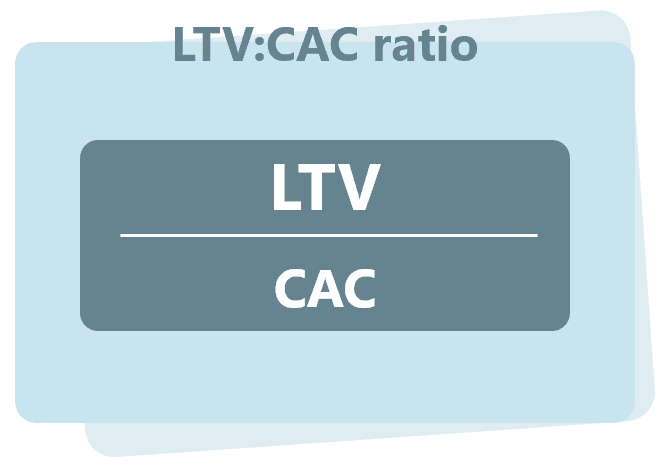
LTV:CAC ratio:
Think of LTV: CAC as a measure of your acquisition “Investment” in a customer. Over the lifespan of that customer, how much gross profit will they generate you?
How much did you acquire that customer for? Was it worth it? That’s what this ratio helps you understand:
Scenario: Let’s continue with the example:
- LTV = $1100 (the gross profit you make from this customer over their lifespan)
- ($275 gross profit per order x 4 orders = $1100)
- CAC = $125 (what you spent to acquire that customer)
LTV:CAC = $1100 / $125 = 8.8
This means you generated 8.8x gross profit return on every dollar spent on acquisition over the lifespan of that customer (ex. 3 years).
BUT…there’s also a way to measure HOW FAST you get a return on your Acquisition Costs, this is the CUF:CAC ratio…
CUF to CAC ratio:
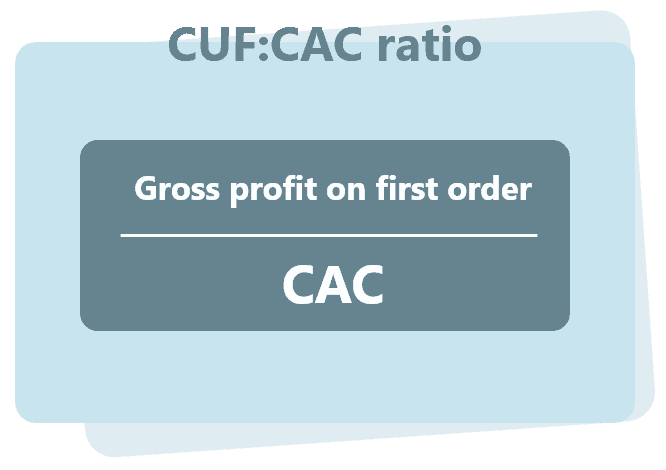
CUF (Cash Up Front) to CAC is a measure of cashflow health in relation to your acquisition costs.
For the purposes of mobile tire shops, consider CUF as gross profit on the first order.
- Good scenario:
- ex. $298 gross profit (CUF) : $98 (CAC) = 3:1
- this means you have $200 left to acquire 2 more customers!
- ($98 x 2)
- Great!
Now let’s look at a BAD scenario:
- Bad Scenario
- ex. $220 (CUF) : $180 (CAC) = 1.2:1
- this means you only have $40 left to acquire any new customers.
- But new customers cost you $180 CAC, so you CANNOT afford to acquire new customers (self sufficiently) so you CANNOT GROW (on your own).
- NOTE: If you can get VC (venture capital) investment, or a line of credit (bank), other debt instrument – you CAN swing this with using debt if capturing a market share is the primary goal (instead of profitability)
Looking to dig deeper into how CAC, CUF:CAC, and cashflow affects your business success? Check out this article: “Mastering Your P&L for Mobile Tire Shops in 2025“
So What Should My CAC Be?
Only you can determine what your CAC should be, based on your 3 Statement Financial Model with your numbers, and understanding your desired CUF:CAC ratio, and LTV.
But, for the sake of curiosity, here’s some Industry reference points on CAC.
Industry Reference Points:
The figures you’re about to explore have been collected by FirstPageSage. This data isn’t just pulled out of thin air; it comes directly from analytics accounts, ensuring its reliability and relevance.
|
Industry |
Average Organic CAC |
Average Paid CAC |
|
Addiction Treatment |
$357 |
$506 |
|
Automotive |
$178 |
$234 |
|
Aviation |
$475 |
$708 |
|
CBD |
$87 |
$72 |
|
Construction |
$201 |
$294 |
|
eCommerce |
$64 |
$68 |
|
Electrical Contractors |
$98 |
$121 |
|
Entertainment |
$82 |
$106 |
|
Financial Services |
$146 |
$173 |
|
Higher Education & College |
$134 |
$177 |
|
Home Builders |
$151 |
$197 |
|
Home Services |
$90 |
$116 |
|
Hotels & Resorts |
$208 |
$247 |
|
HVAC Services |
$83 |
$98 |
|
Legal Services |
$189 |
$457 |
|
Medical Device |
$131 |
$126 |
|
Medical Practices |
$120 |
$176 |
|
Real Estate |
$103 |
$226 |
|
SaaS |
$135 |
$197 |
|
Solar Energy |
$206 |
$288 |
Key Points:
- You MUST first master your 3 Statement Financial Model (P&L Statement, Cashflow Statement, & Balance Sheet)
- DO NOT let “someone else” tell you what your CAC should be, they have NO IDEA about your:
- Financial Goals (how much, by when?)
- Risk Profile (your bank balance, willingness to carry debt, etc)
- Expense structure (what costs, where, when?)
- Retail pricing (selling to who, for how much?)
- Target market (what city? what cost of living?)
...I'm think I'm making good money, but at the end of the month...where did the money go??....
—ANONYMOUS MOBILE TIRE OPERATOR, USA
Gain financial confidence and the conviction to act by mastering the 3 Statement Financial Model in this article: Financial Modeling To Grow Your Mobile Tire Shop in 2025

Put your Tire E-commerce on autopilot, with TreadCommand
Say goodbye to clunky & cookie-cutter tire shop management software. Grow your mobile tire shop confidently with the best-in-class automated e-commerce tire platform that customers & operators love.
Closing Remarks
Understanding the fundamentals of CAC, LTV, LTV:CAC, & CUF:CAC is crucial. If you got this far in the article, congrats you’re ahead of 80% of your competition.
If you feel like you need to read this over again for it to sink in – don’t be discouraged!
Just remember, if you’re not learning – you’re not earning!
Till next time!